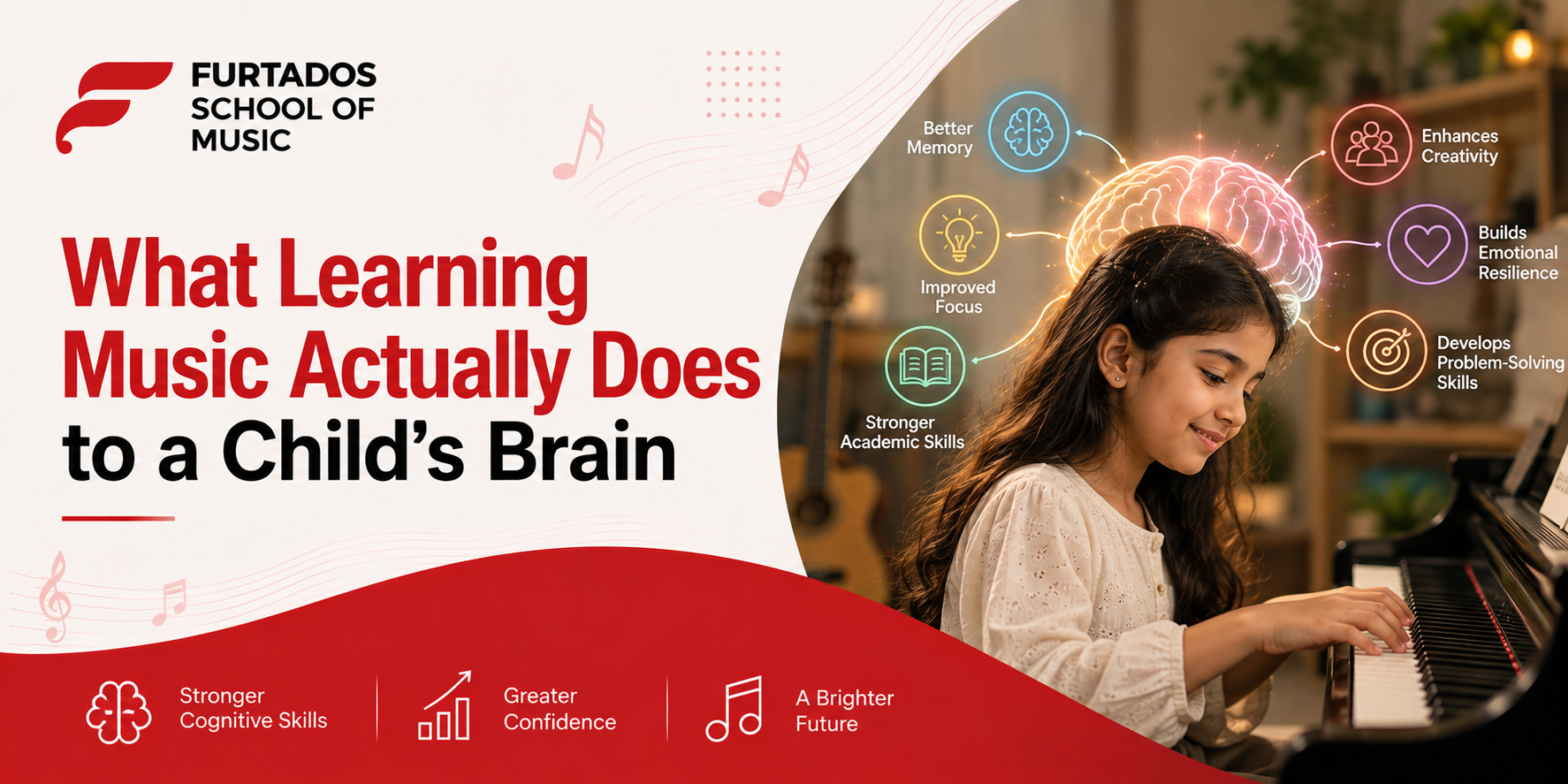
Have you ever watched a child hear a song and light up before understanding a single word? That spark is not magic. It is a young brain responding to rhythm, melody, and emotion all at once. Parents often ask whether music is just a pleasant hobby or something deeper. Research suggests it is deeper. Here is what happens inside your child’s mind when they start learning music. The benefits of learning music for children reach far beyond the stage.
How Music and Brain Development Work Hand in Hand
Few activities ask a brain to do so much at once. When a child plays a keyboard, the ears listen, the eyes read, and the fingers move. Memory recalls the last line while emotion shapes the next one. Several brain regions fire together and learn to cooperate.
This teamwork sits at the heart of music and brain development. Studies on children who train in music show stronger links between the auditory and motor areas of the brain. Some research also finds changes in how both brain halves share information. Over months of practice, these connections grow more efficient, much like a path that gets clearer with every walk.
Why Music Lessons for Kids Sharpen Language and Listening
Music and speech share a lot of ground. Both rely on pitch, rhythm, and timing. A child who hears a half step between two notes also catches tiny differences in spoken sounds. That skill helps with pronunciation, vocabulary, and early reading.
Parents often notice this first. A child in music lessons for kids starts to listen more closely at home and at school. They pick up new languages with more ease. They also remember song lyrics, poems, and rhymes faster. Singing, in particular, turns language into something the whole body can feel.
Memory, Focus, and the Hidden Skills Behind Every Practice Session
Think about what a child does during a ten minute practice. They hold a pattern in mind and watch a beat. They fix a mistake and try again. Psychologists call these skills working memory, attention, and self control. Schools depend on all three.
Music trains them in a gentle, enjoyable way. A child does not feel like they are doing mental exercise. They simply want to play the tune properly. Repetition then builds patience, and patience builds focus. Over time, this focus follows your child into homework, exams, and everyday problem solving.
The Emotional Benefits of Learning Music for Children
The brain does not only think. It also feels, and music speaks to feeling directly. A child who struggles to say they are upset can often play or sing it. Music gives big emotions a safe place to go. Many parents see calmer evenings after a good practice session.
Confidence grows in a similar way. Every small win, from a first clean chord to a first recital, tells a child that effort pays off. Facing an audience, even a tiny one at home, teaches courage. Those lessons stay long after the song ends.
Teamwork, Rhythm, and the Social Side of Music and Brain Development
Music rarely happens alone. In group classes, children listen to each other and match their tempo. They wait for their turn and blend into one sound. These moments teach cooperation without a single lecture. The social brain gets a workout alongside the musical one.
Shared music also builds belonging. A shy child who hums along with classmates feels part of something. A confident child learns to support quieter voices. Many parents tell us that friendships formed in music class last for years. That sense of connection supports emotional health, which in turn supports learning everywhere else.
Performances add another layer. Preparing for a recital teaches planning, rehearsal, and calm under pressure. A child learns that nerves are normal and that preparation tames them. This is among the most valuable benefits of learning music for children. It carries into school presentations and job interviews later in life.
Early Years, Plastic Minds, and Why It Is Never Too Late
A child’s brain is remarkably plastic. It reshapes itself in response to experience. Researchers who followed young learners found that early music training can shape how the brain processes sound. Starting in the early school years often brings the strongest effects, because the brain is still building its basic wiring.
That said, a late start does not close the door. Teenagers and adults also build new connections when they learn an instrument. If your child is ten, twelve, or fifteen, the benefits are still real. The best time to begin is when your child is curious and willing.
How Parents Can Support Music Lessons for Kids at Home
Let us be honest about one thing. Music will not turn a child into a genius overnight. The gains appear slowly, through steady practice over months and years. That is why your support matters more than any shortcut. Patience from parents becomes patience in the child.
Keep practice short and regular, even if it is only fifteen minutes. Praise effort rather than perfection. Listen to what your child plays and ask them to teach you a piece. Let them choose an instrument they love, because joy keeps them coming back. A child who enjoys the sound will practise without being asked. When motivation dips, remind them that every musician has felt the same.
Give Your Child’s Brain a Musical Head Start With FSM
A good teacher and a supportive space make all the difference. Furtados School of Music (FSM) has touched more than 3 lakh families across India with joyful, structured music education. Your child can begin with vocal classes in Indian and Western styles to build voice, rhythm, and confidence. They can also explore instrument classes in keyboard, piano, guitar, drums, violin, and more. Classes run at centres, in schools, and online.
Let your child’s brain grow with every note. Book a demo class with FSM today and watch their curiosity turn into skill.