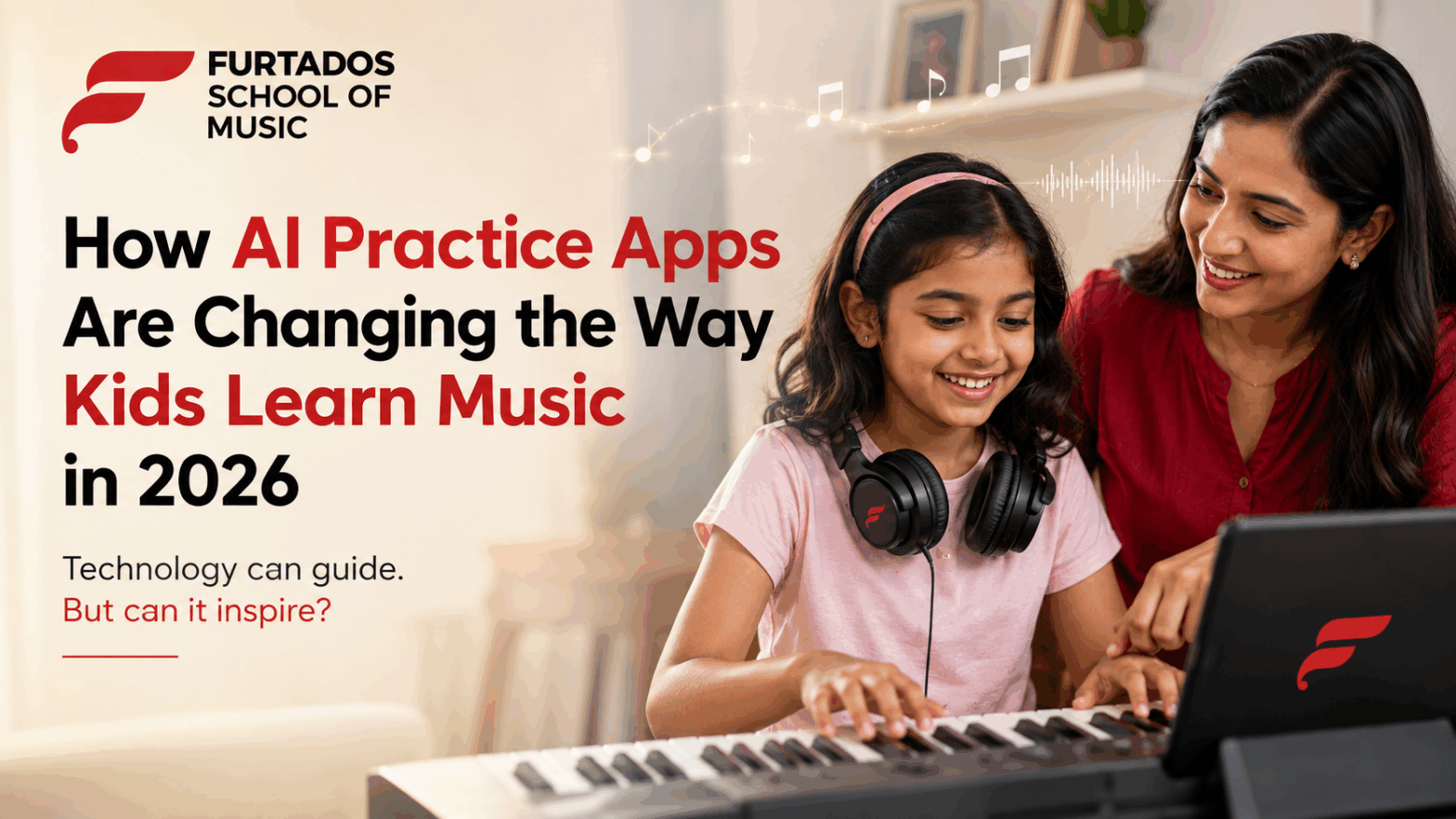
There was a time when practising music meant sitting at the music keyboard, opening the lesson book and playing the same passage until Mum or Dad said, “Again!” Today, music practice looks a little different. Children can play along with digital tools that listen, respond, track progress and offer feedback almost instantly. For a child, that can make practice feel less like homework and a lot more like an activity they actually want to return to.
This is where AI practice apps are beginning to change the way children experience music learning in 2026. But does that mean technology is replacing music teachers? Not quite. In fact, the most exciting possibility is not AI versus teachers, but technology working alongside teachers to make learning more personalised, engaging and enjoyable.
So, What Exactly Can AI Do During Music Practice?
Think about what happens between two music lessons. A child attends a class on Saturday, learns a new song, gets feedback from the teacher and is given something to practise at home. By Monday, however, the teacher isn’t sitting beside them. This is where an AI-powered practice tool can become a useful companion.
Depending on the platform, these tools can listen to a child’s playing, identify notes or rhythm-related mistakes, track practice and provide instant feedback. Instead of waiting until the next class to discover what needs improvement, children can receive guidance while they are practising. That creates a simple learning loop: play, receive feedback, understand what went wrong and try again.
For parents, this can make practice time more purposeful. Rather than simply asking a child to practise for 20 minutes, they can spend those 20 minutes working on the areas where the child actually needs more support.
Practice Can Become More Personalised
Every child learns differently. One child might pick up a melody after hearing it twice, while another may need several attempts. Some children naturally understand rhythm, while others need more time with reading notes or coordinating both hands.
This is where personalised technology can be useful. AI-powered music learning tools can analyse a learner’s performance and adapt exercises or feedback according to their progress. Instead of pushing every child through exactly the same practice routine, technology can potentially provide more targeted support.
For a child learning the keyboard, this could mean spending more time on a tricky section of a song rather than simply moving ahead because the lesson says it is time for the next exercise. The result is a practice experience that can better match the child’s pace, ability and confidence.
The Keyboard Starts Feeling Less Like Homework
Let’s be honest: getting children to practise isn’t always easy. Parents have probably heard every variation of “I’ll do it later!” when it comes to practice time.
This is one reason interactive technology can be so useful. Digital learning platforms can introduce challenges, visual feedback, progress indicators and interactive exercises that make repetition feel less repetitive. For children, the experience can feel more playful and rewarding.
That matters because motivation plays a huge role in music learning. A child who enjoys returning to the instrument is more likely to build a regular practice habit. The objective isn’t to turn every lesson into a video game. It is to make the process engaging enough that children develop the curiosity to keep exploring music.
Feedback Doesn’t Have to Wait Until the Next Class
One of the most useful aspects of AI-supported practice is the possibility of immediate feedback. Imagine your child playing a melody and being able to understand almost instantly whether they played the right notes or maintained the rhythm.
That can change the traditional practice cycle. Instead of playing something incorrectly several times and waiting until the next lesson to be corrected, children can get an indication of where they need to improve and have another go.
Of course, this doesn’t mean every mistake needs to be highlighted. Children also need the freedom to experiment, improvise and simply play. Music should never feel like a constant test where an app is waiting to tell them whether they are right or wrong.
The best technology should support learning while leaving plenty of room for creativity.
But Here’s the Important Part: AI Cannot Replace the Teacher
This is perhaps the most important point for parents considering technology-assisted music learning. An app can recognise a wrong note, but a teacher can understand why a child is struggling with that note. An app can track practice, but a teacher can notice when a child is losing confidence or becoming excited about a particular song.
A digital tool can suggest what to practise, but a teacher can inspire a child to actually want to practise.
Music is about much more than accuracy. It involves expression, listening, creativity, confidence and connection. These are areas where human guidance continues to matter enormously.
So, the future isn’t necessarily AI versus teachers. It is much more likely to be AI + teachers + children, with each playing a different role in the learning journey.
What Should Parents Look For in 2026?
If you’re searching for keyboard classes near me or exploring online keyboard classes for your child, don’t choose a programme simply because it has the words “AI-powered” attached to it. Technology is only as valuable as the learning experience built around it.
Parents should look at whether their child gets access to a real teacher, whether the programme adapts to the child’s pace and whether technology is being used to help the child understand music rather than simply mark answers as right or wrong. It is also worth asking whether there is enough space for creativity, song choices, experimentation and genuine enjoyment.
The best learning environment should make technology feel like a helpful companion rather than another screen demanding your child’s attention.
Where Does FSM Fit Into This?
At Furtados School of Music, technology is designed to support the learning journey rather than replace the teacher. Through FSM Learn Buddy, technology supports areas such as teacher scheduling, customised classroom learning, assessments and student-wise progress tracking, helping create a more connected experience for students, teachers and parents.
For younger children beginning their keyboard journey, Keys Are Fun combines digital learning with hands-on resources designed for children aged 4+. The programme brings together activity booklets, practice sheets, stickers, a parent guide and interactive learning experiences to help children build musical foundations while keeping practice playful and age-appropriate.
Because ultimately, a child doesn’t fall in love with an algorithm. They fall in love with music. They fall in love with the first song they can play from beginning to end, recognising a melody they heard somewhere or proudly showing their parents something new they learnt that morning.
AI can make the journey smarter. It can make practice more personalised, interactive and measurable. But the teacher, the instrument and the joy of making music remain at the heart of it.
And perhaps that’s what music learning in 2026 should really look like: technology that knows when to guide, teachers who know when to listen, and children who simply can’t wait to play the next song.