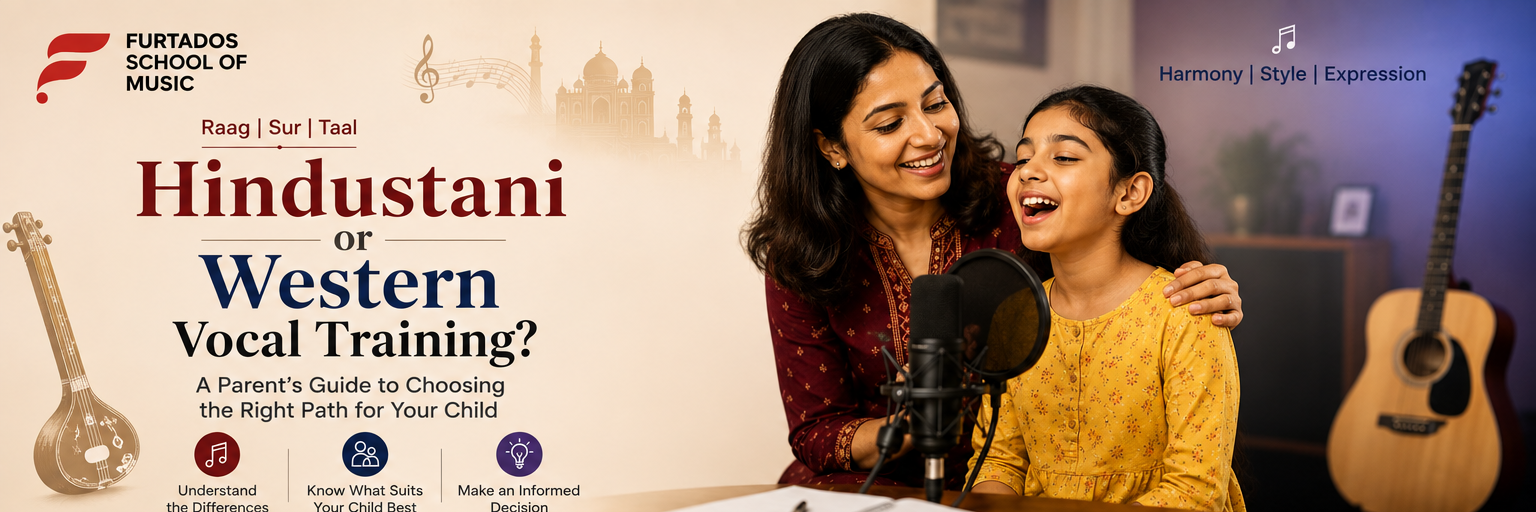
Your child loves to sing. They are constantly humming around the house, performing their favourite songs for anyone who will listen, or turning the living room into a stage the moment music starts playing. Naturally, the next question comes up: should you put them in Singing Classes Near Me, and if you do, should you choose Hindustani or Western vocal training?
For many Indian parents, this can be a surprisingly difficult choice. Both styles can build musicality, confidence and vocal ability, but they approach music differently. One isn’t necessarily “better” than the other. The right choice depends on what your child enjoys, what kind of music they connect with and what you want their learning journey to look like.
The good news is that children don’t have to decide their entire musical future on their first day of class. At the beginner stage, the most important thing is finding a structured learning environment where they can develop a healthy relationship with their voice while discovering the kind of music they enjoy.
What Is the Difference Between Hindustani and Western Vocal Training?
The easiest way to understand the difference is to look at how each tradition approaches melody, rhythm, technique and repertoire.
Hindustani classical music is one of India’s major classical traditions and places considerable emphasis on sur, raag and taal. A learner gradually develops an understanding of notes, melodic movement, rhythmic cycles and the distinctive character of different ragas. Training can include exercises such as alankars and palta before progressing towards more developed compositions and forms. FSM’s current Indian vocal programme, for example, introduces learners to sur, raag, taal, alankars, palta, thaats and bandish as they progress through the curriculum.
Western vocal training approaches music through a different musical framework. Depending on the programme, students may work on pitch, scales, rhythm, harmony, breath management, articulation, vocal registers and repertoire across styles such as pop, rock, jazz and classical singing. FSM’s Western vocal curriculum includes areas such as breathing, vocal range, pitch, modulation, posture and stage performance, with repertoire selected according to the learner’s level.
Neither approach is simply about teaching a child to “sing better”. Both are ways of developing musical ears, technique and expression, but they take different routes to get there.
When Hindustani Vocal Training May Be the Right Choice
If your child naturally gravitates towards Indian music, Hindustani training can provide a strong foundation.
Perhaps they enjoy Bollywood songs, ghazals, devotional music or Indian classical performances. Perhaps they already imitate melodies they hear at home and seem particularly interested in how notes move within an Indian musical phrase. These interests can be useful clues.
A structured Hindustani programme introduces children to the building blocks behind the music they hear. Instead of simply learning a song by copying it, they begin to understand why particular notes, phrases and rhythmic patterns work together.
This is one of the reasons parents searching for Hindustani Singing Classes Near Me should look beyond the song list offered by a class. A good programme should have a clear progression. Beginners need time to develop pitch, breathing, listening and voice control before being pushed towards increasingly complex repertoire.
Hindustani training can also encourage patience. A raga is not something that can be meaningfully understood in a handful of classes. Children gradually develop familiarity with notes and melodic patterns, and that process can teach them to listen carefully rather than simply rush towards the next song.
India’s education framework increasingly recognises the value of this kind of artistic learning. NEP 2020 places emphasis on experiential learning and art-integrated education, with the broader objective of developing well-rounded learners rather than focusing only on academic outcomes.
When Western Vocal Training May Be a Better Fit
Western vocal training may appeal more to children whose playlists are filled with pop, rock, musical theatre or contemporary English-language music.
If your child is constantly singing along to international artists, enjoys performing songs in English or dreams of being on stage, a Western vocal programme can provide a framework that connects naturally with those interests.
Technique becomes an important part of the learning process. Children can work on breathing, pitch accuracy, vocal range, articulation, posture and voice modulation while gradually learning how to approach different musical styles. FSM’s Western vocal programme, for example, covers these areas and introduces students to styles including pop, rock and jazz. The programme also includes opportunities for stage performances and workshops, helping learners become more comfortable performing in front of others.
Western vocal education can also offer a clearly structured progression for families who want formal milestones. Trinity College London, for instance, offers singing pathways covering both Classical & Jazz and Rock & Pop, with graded assessments from Initial through Grade 8. Importantly, Trinity states that its graded music exams have no minimum or maximum age requirement, making formal music education accessible to learners at different stages of life.
That doesn’t mean every child needs to take an exam. Certifications are only one possible goal. For many children, learning songs, developing technique and becoming a confident performer can be more important than completing grades.
Don’t Choose Based Only on the Language of the Songs
This is where parents can sometimes overthink the decision.
A child singing Hindi songs doesn’t automatically need Hindustani classical training, just as a child singing English songs doesn’t automatically need Western vocal training.
Repertoire and vocal methodology are related, but they aren’t identical.
A child can love Bollywood music and still benefit from learning Western vocal techniques. Another child may enjoy English pop while developing a strong foundation in Indian classical music. Music is much more fluid than the categories we sometimes use to describe it.
The better question is: What kind of musical foundation will help this particular child stay interested and grow?
If your child enjoys the structure and depth of Indian classical music, Hindustani could be a natural fit. If they are excited by contemporary performance and genres such as pop or rock, Western vocals may keep them more engaged. And if they are curious about both, there is no rule saying they can only explore one.
What Parents Should Look for in Vocal Classes
Once you’ve narrowed down the style, the next decision is where your child should learn.
Searching for Vocal Classes Near Me will probably bring up plenty of options, but proximity should not be the only consideration. The teacher, curriculum, class size, learning environment and opportunities for performance can have a much greater influence on a child’s experience.
Start with the teacher. Children respond differently to different teaching personalities, and a technically knowledgeable teacher isn’t necessarily the right fit if a child feels uncomfortable asking questions or making mistakes.
Then look at the curriculum. Are children actually developing vocal technique, or are they primarily learning songs? Is there attention to pitch, breathing, rhythm and voice care? Does the programme become more challenging as the learner progresses?
Performance opportunities are worth considering too. Performing isn’t compulsory for every child, but having the option to sing in a workshop, recital or school event can gradually help children become more comfortable sharing what they have learnt.
FSM, for example, offers both individual and group vocal lessons, along with workshops and performance opportunities. Its centres use structured curricula and dedicated spaces for learning and performance, while online classes provide another option for families who need flexibility.
What If Your Child Likes Both?
This may actually be the easiest situation.
If your child enjoys both Indian and Western music, you don’t necessarily have to force an immediate either-or decision. Exposure to different musical systems can help children become more versatile listeners and performers.
There are also skills that overlap between the two. Breath control, pitch accuracy, rhythm, listening, articulation and confidence are important across singing styles. FSM itself offers both Indian and Western vocal programmes, and its Indian vocal curriculum includes foundational work on breath control, voice modulation, scales and notes, while its Western programme similarly develops breathing, pitch, range, modulation and performance skills.
As children grow, their preferences may become clearer. A child who starts with Indian classical vocals might eventually become interested in contemporary music. Someone who begins with Western pop may later discover a fascination with Hindustani classical music.
Music learning doesn’t have to be a straight line.
The Right Choice Is the One Your Child Wants to Return To
Perhaps the most useful test is also the simplest one.
After a few classes, does your child look forward to singing?
That matters.
A technically excellent programme will struggle to make a difference if a child is constantly reluctant to attend. On the other hand, when children genuinely enjoy what they are learning, they are far more likely to listen, practise and gradually develop the discipline that music requires.
Parents don’t need to identify the future singer hiding inside their child. They simply need to create an opportunity for that interest to develop.
At Furtados School of Music, children can explore both Indian vocals – including Hindustani classical – and Western vocals through structured programmes designed for different experience levels. FSM offers online and offline learning, trained faculty and opportunities for students to develop not just vocal technique but also confidence and performance skills.
So, when you’re comparing Singing Classes Near Me, don’t ask only, “Which style is the best?”
Ask your child what they love listening to. Pay attention to the songs they sing without being asked. Notice whether they are drawn towards Indian melodies, Western pop, classical music or a little bit of everything.
Because the best vocal training isn’t necessarily the one with the most impressive label.
It’s the one that helps your child enjoy singing today while giving them the foundation to discover where their voice can take them tomorrow.