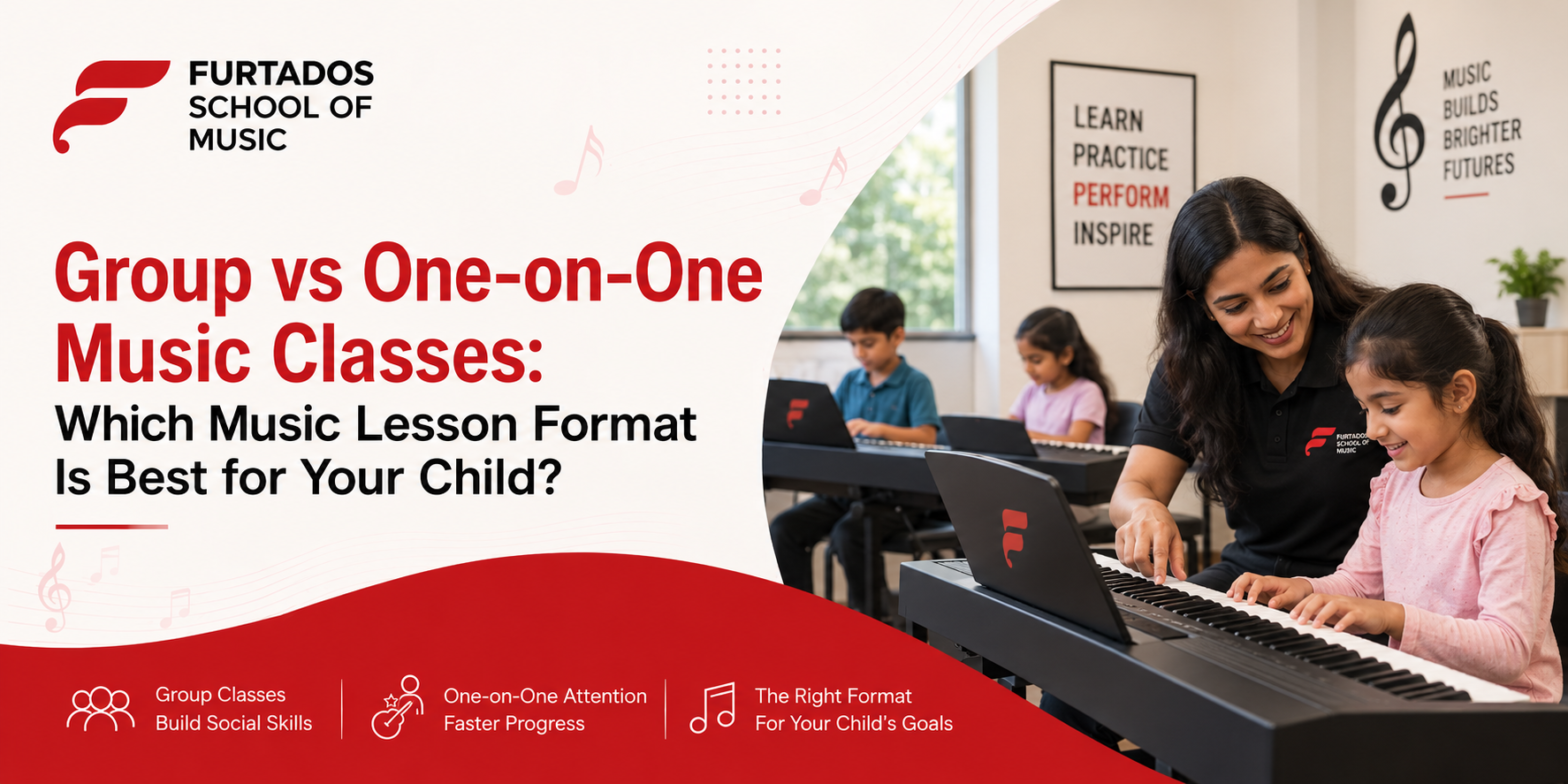
A five-year-old sits alone with a teacher and a keyboard, repeating the same four notes until they feel natural. Down the hall, six children clap out a rhythm together, giggling every time someone loses the beat. Both rooms teach music. Both rooms produce real musicians. The question most parents actually struggle with is not whether music lessons work, it is which music lesson format will actually hold their child’s attention long enough to work, and which one will still feel right a year from now.
What One-on-One Music Lessons Actually Offer
In private music lessons for kids, the entire session revolves around one student. A teacher can slow down the instant a concept does not land, or move faster the moment a child gets bored of repetition. Pacing becomes personal instead of averaged across a room. This format tends to suit children preparing for graded exams, competitive auditions, or a specific instrument where technique needs constant, individual correction, such as violin bowing, breath control for wind instruments, or piano fingering.
The trade-off is exposure. A child who only ever plays alone with a teacher rarely learns how their sound fits with someone else’s. Confidence built in a quiet, one-on-one room does not always survive the first time a child has to perform in front of an audience, and timing that feels solid in isolation can wobble the moment another instrument enters the picture.
What Group Music Classes Bring to the Table
A group music class trades individual pacing for something private lessons cannot replicate: peer energy. Children watch classmates attempt the same rhythm, notice their own mistakes by comparison, and often correct themselves faster because nobody wants to be the one who falls out of time. Group settings also build ensemble skills early, teaching a child to listen while playing, not just to play correctly in isolation, which matters the moment they join a band, choir, or orchestra later on.
For younger children especially, a group music class often feels less like a lesson and more like play, which keeps motivation high during the years when attention spans are shortest. The obvious limitation is depth. A teacher managing six or eight students cannot correct one child’s hand position the way a private teacher can, every single session, and a genuinely shy child can sometimes go an entire class without being noticed.
Group vs One-on-One Music Classes: What the Difference Actually Comes Down To
Every comparison between group vs one-on-one music classes eventually reduces to three factors: pace, personality and purpose. Pace, because private lessons move at exactly the speed one child needs, while group classes move at whatever speed keeps the room together. Personality, because some children thrive on quiet focus, while others need the social mirror of classmates to stay engaged. Purpose, because a child preparing for a specific grade exam has different needs than a child who simply wants to enjoy music without pressure.
None of these factors point to one format being universally correct. They point to matching the format to the specific child sitting in front of the decision, not to whichever option sounds more serious on paper or looks better on a school application.
Signs Your Child Will Thrive With Private Lessons
Some signals show up early. A child who asks the same question three times until it truly clicks, who gets frustrated in noisy environments, or who is already working toward a graded exam usually benefits more from private music lessons for kids. So does a child learning a technically demanding instrument, where a teacher needs to watch posture, breath or bowing at close range, correcting small errors before they turn into habits.
Signs Your Child Will Thrive in a Group Setting
Other children show the opposite pattern. A child who lights up around classmates, who learns faster by watching others try first, or who has never expressed interest in a specific instrument tends to do better easing in through a group music class. Group formats are also a lower-pressure way to test whether a child genuinely enjoys music before a family commits to the higher cost and structure of individual training.
So Which Format Actually Suits Your Child
Age matters as much as personality. Children under seven generally respond better to group formats built around rhythm games and singing, while older children preparing for structured exams tend to progress faster with individual attention. Many families eventually land on a hybrid: a group music class for the social, rhythmic foundation, paired with private music lessons for kids once a child commits to a specific instrument. Neither path is a downgrade from the other; they simply serve different stages of the same musical journey.
Cost, Commitment and Schedule: The Practical Side of the Decision
Budget and time are rarely mentioned in the parenting blogs, but they shape this decision as much as personality does. Group music class formats are almost always more affordable per session, since the teacher’s time is shared across several students, which makes them an easier starting point for a family still testing whether their child will stick with an instrument. Private music lessons for kids, by contrast, cost more per hour but compress progress into far fewer sessions, since none of the time is spent waiting for a turn. Families juggling school, sport and other commitments often find that a private lesson once a week achieves more than two group sessions, simply because every minute is spent on their own child.
Why FSM Makes This Decision Easier for Parents
This is exactly the kind of decision FSM (Furtados School of Music) is built to simplify. Rather than forcing a family to guess and commit upfront, FSM runs both formats side by side across its centres, so a child can start in a group music class to build rhythm and comfort, then transition into private music lessons for kids the moment they show a clear pull toward a specific instrument. Teachers across FSM track a student’s pace, confidence and focus in real time, and can recommend a switch in format long before a parent notices the signs on their own. That flexibility is what most one-off local teachers simply cannot offer, since it depends on having both formats, and trained faculty for each, under one roof.
Give Your Child the Format That Actually Fits Them
Choosing between group vs one-on-one music classes does not need to be a guessing game. Parents can book a free trial class with FSM to see which setting actually brings out their child’s focus and confidence, without committing to a format that was never right for them in the first place.