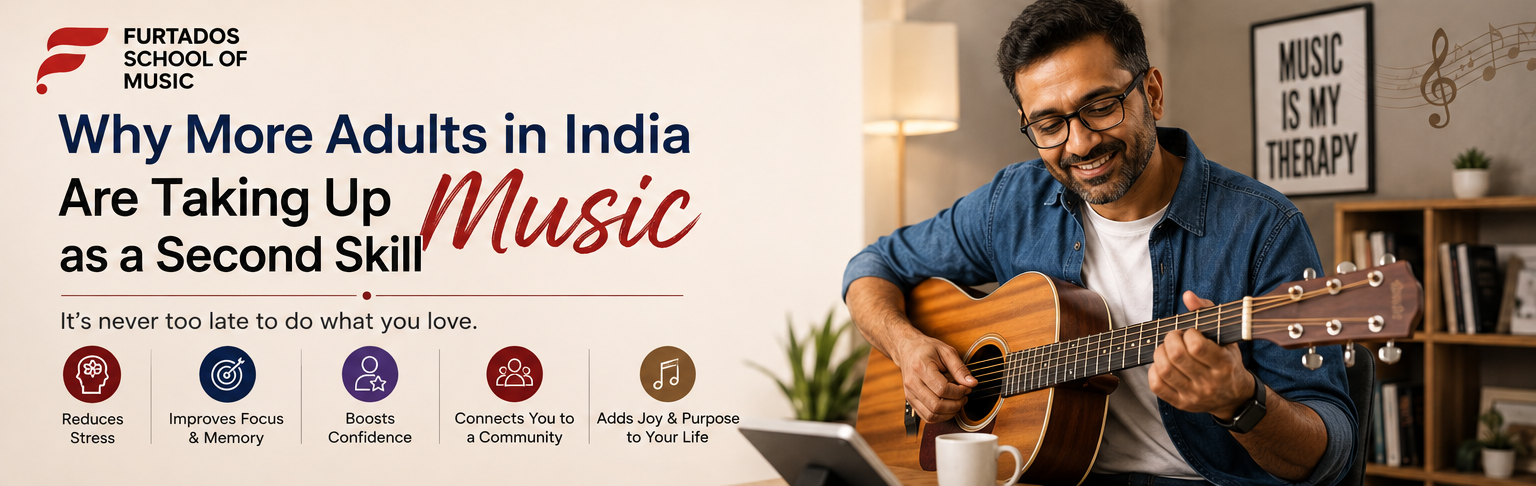
For a long time, learning music in India was treated as something you did while growing up. Parents enrolled their children in piano, keyboard, guitar or vocal classes, hoping they would develop a hobby, discover a talent or perhaps even pursue music seriously one day. Once school, college and work took over, however, music often moved to the background.
That mindset is gradually changing.
Today, an increasing number of adults are making room for music in their lives – not necessarily because they want to become professional musicians, but because they want to learn something that belongs entirely to them. A working professional may spend the day in meetings and return home to pick up a guitar. A parent may finally start piano lessons after years of putting the idea aside. Someone who grew up listening to Indian classical music may decide to explore vocals, while another person may simply want to learn to play the songs they have been listening to for years.
There may not yet be a single nationwide survey that tells us exactly how many Indian adults are taking up music as a second skill, but the broader shift towards lifelong learning is visible. India’s Time Use Survey 2024 found that 21.4% of people aged six and above participated in learning activities on an average day. At the same time, the country’s education policy has increasingly recognised arts and creative learning as an important part of holistic development.
Music fits naturally into this changing idea of learning: it is a skill you can begin at almost any age, develop at your own pace and continue enjoying long after a course or certification is complete.
The Adult Learner Is Looking for Something Different
The biggest difference between learning music as a child and learning it as an adult is often the reason behind the decision.
Children are frequently introduced to music by their parents. Adults choose it for themselves.
That distinction changes the entire experience. An adult who searches for Music Classes Near Me is rarely just looking for something to fill an hour. They may be looking for a creative outlet after a demanding workday, a way to reconnect with an old interest or simply an opportunity to learn something that has nothing to do with their professional responsibilities.
There is also much less pressure to turn the skill into a career.
For one adult, success could mean playing a favourite song on the guitar. For another, it might mean sitting at a piano and understanding chords for the first time. Someone else may want to become more confident with vocals or eventually perform for friends and family. None of these goals requires becoming a professional musician.
And that is perhaps what makes adult music learning so appealing. The definition of success belongs to the learner.
“I Always Wanted to Learn That”
There is another familiar story behind many adult learners: the instrument they never got around to learning.
Perhaps there was a guitar at home during college. Maybe piano lessons were considered but never started. Perhaps singing was always a passion, but studies and work took priority. Life has a way of filling calendars, and personal interests are often the first things to be postponed.
Years later, the interest is still there.
This is where the growing accessibility of music education makes a real difference. An adult no longer necessarily has to reorganise their entire schedule around learning. Music education can fit around work and family commitments through online classes, centre-based lessons and home tuition.
At Furtados School of Music, for instance, learners can choose between online and offline formats, with individual and group lessons available across instruments such as piano, guitar, vocals and drums. FSM also offers lessons designed for different levels and ages rather than assuming that every learner is beginning from the same place.
That flexibility matters for adults because the question is often not, “Do I want to learn?” It is, “Can I realistically fit this into my life?”
You Don’t Have to Be Naturally Musical
One of the biggest barriers for adult beginners is the belief that they have somehow missed their chance.
“I have no sense of rhythm.”
“I’m too old to start.”
“I don’t know how to read music.”
“I’ve never played an instrument before.”
These are common concerns, but none of them needs to prevent someone from beginning.
Learning music is not an audition. A structured programme allows beginners to understand an instrument step by step, develop coordination, build musical vocabulary and gradually move towards playing or singing complete pieces. The advantage of being an adult learner is that you often come with something children are still developing: a clear understanding of what you enjoy and why you want to learn it.
Someone searching for Piano Classes Near Me, for example, may already know that they want to play film music, contemporary songs or classical pieces. A beginner guitarist may want to accompany their own singing. Someone interested in vocals may have a particular genre or style they want to explore.
These personal goals can make learning more meaningful because the learner can connect technique with something they actually want to do.
Why Guitar, Piano and Vocals Continue to Attract Adults
Certain instruments naturally lend themselves to adult learning because they can become part of everyday life.
The guitar is an obvious example. It is portable, versatile and works across a wide range of musical styles. An adult can learn basic chords and gradually progress towards playing songs they enjoy, making it a satisfying choice for someone who wants to see tangible progress.
The piano and keyboard offer a different experience. Because the notes are laid out visually, beginners can develop an understanding of melody, chords and harmony while also learning pieces they recognise. This makes piano particularly attractive to adults who want both practical playing skills and a deeper understanding of how music works.
Vocals are perhaps the most accessible of all because the instrument is always with you. Learning to sing, however, involves much more than simply knowing the lyrics. Breath control, pitch, rhythm, diction and vocal technique all contribute to becoming a more confident singer.
This is why choosing the right teacher and learning environment can matter as much as choosing the instrument itself. A beginner needs guidance that is structured enough to build proper foundations but enjoyable enough to make them want to continue.
Music Gives Adults a Different Kind of Achievement
Modern professional life is filled with measurable outcomes: targets achieved, projects completed, promotions earned and deadlines met. Music offers a very different kind of progress.
It is the satisfaction of playing a difficult passage correctly after struggling with it for weeks. It is recognising a chord progression you once couldn’t hear. It is singing a song without worrying about whether you sound “good enough.” It is the first time you realise that something which once seemed difficult has become familiar.
These moments may look small from the outside, but they are exactly what makes learning a new skill rewarding.
Music also creates an opportunity to be present. Instead of consuming another piece of content on a screen, you are actively listening, responding, remembering and creating. For adults whose days are dominated by digital work and constant notifications, that can be a refreshing change of pace.
The Rise of Lifelong Learning Makes Music More Relevant
The idea that education ends when formal schooling ends is becoming increasingly outdated.
People learn new languages, take up fitness, study photography, explore cooking, develop digital skills and start creative hobbies well into adulthood. Music belongs naturally in this wider movement towards lifelong learning.
India’s National Education Policy 2020 has also strengthened the emphasis on arts, creativity and holistic education, moving away from rigid divisions between academic and creative pursuits. UNESCO’s policy monitoring platform notes that NEP 2020 mainstreams arts and creative endeavours as part of holistic development.
While these policy changes are primarily focused on education, they reflect a broader cultural shift: creative skills are increasingly being viewed as meaningful forms of learning rather than optional extras.
For adults, that can mean giving themselves permission to learn something simply because it adds value to their lives.
Starting Doesn’t Have to Mean Starting Over
One of the most encouraging things about becoming a music learner as an adult is that your previous experience still counts.
Maybe you learnt keyboard for two years as a child and stopped. Perhaps you sang in a school choir. Maybe you played guitar during college and haven’t touched it in a decade.
You don’t necessarily have to go back to the very beginning.
A good music programme can identify where you are, understand where you want to go and create a path between the two. That is particularly important for adults because their goals can vary significantly. Some want casual learning, while others may want formal grades, certifications or performance opportunities.
FSM’s programmes are designed to accommodate different levels and learning preferences, with courses spanning piano, keyboard, guitar, vocals, drums, violin, ukulele and other instruments. Its centres offer individual and group lessons, while online learning provides another option for people who need greater flexibility.
The idea is not to force every learner into the same definition of a musician. It is to give them the training and support to develop their own musical ability.
Maybe Your Second Skill Should Be Something You Love
There is a certain freedom in learning music as an adult.
You don’t have to choose it because it will improve your resume. You don’t have to compete with anyone. You don’t have to decide on day one whether you want to perform on stage or simply play in your living room.
You can start with one instrument, one class a week and one song you really want to learn.
Over time, that one class can become a skill. The skill can become a hobby. The hobby can become a passion. And sometimes, it can become something much bigger than you expected.
For adults looking to begin, Music Classes Near Me are no longer simply about finding a teacher in the neighbourhood. The real question is finding a learning environment that understands your goals, your schedule and your starting point.
At Furtados School of Music, music education is built for learners across ages and experience levels, with structured programmes, trained educators and online and offline learning options. FSM was founded in 2011 with the aim of making quality music education accessible to children and adults, and today offers programmes across multiple instruments and learning formats.
So if there is an instrument you’ve been thinking about for years, perhaps the better question isn’t, “Am I too old to learn?”
It’s simply: “Why not start now?”
Because your first skill may have helped build your career.
Your second one could simply help you build a life that sounds a little more like you.