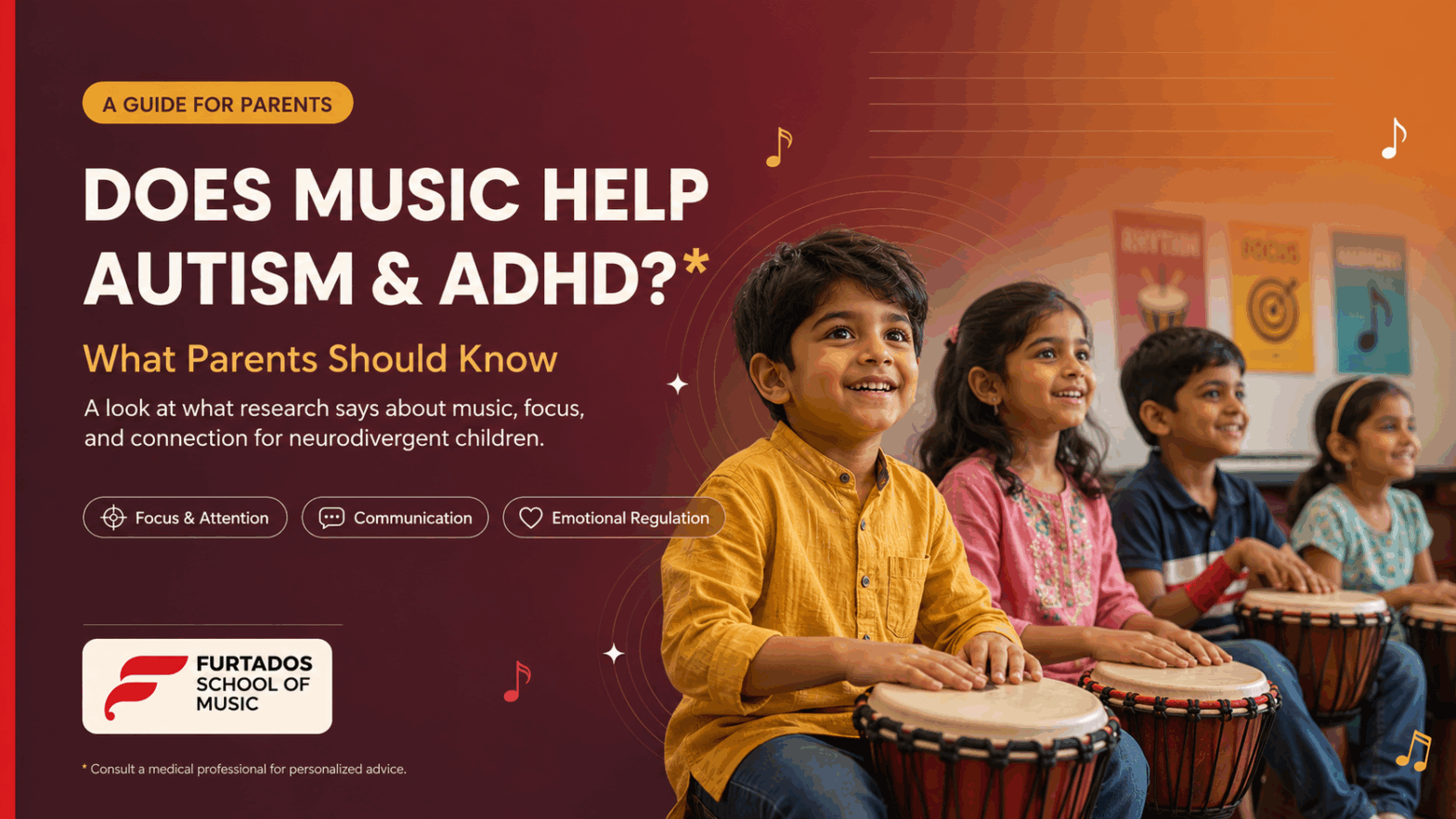
You know the moment. Your child is somewhere else, mid-meltdown, mid-shutdown, or just mid-fidget, and nothing you say seems to reach them. Then a song comes on, and something shifts. A hand starts tapping. A hum starts under the breath. For a few seconds, the noise in their head seems to quiet down, and they are simply, fully there with you.
If you have watched this happen with your own child, you already know something researchers have spent the last two decades trying to prove with data: music reaches places that words sometimes cannot. And if you are a parent of a neurodivergent child, that single observation probably raises a much bigger question. Could learning music, really learning it, not just listening to it, help my child in a lasting way?
Let us walk through what the science actually says, what real music classrooms look like for these children, and why so many parents describe music as the one activity their child never wants to quit.
The Science Is Catching Up to What Parents Already Sensed
For years, this was mostly instinct and anecdote. Now it has data behind it. A 2026 meta-analysis in Frontiers in Psychiatry, pulling together multiple randomized controlled trials, found that structured music therapy for autism produced measurable gains in social interaction and connection among autistic children. Brain scans referenced in the same research showed something remarkable: children engaged in music-based intervention developed stronger functional connections between the auditory, motor, and subcortical regions of the brain compared to children who did not receive it.
Nobody is claiming music is a cure, and no credible researcher or educator ever will. What the evidence does show, again and again, is that music builds real skills: joint attention, emotional regulation, turn-taking, and non-verbal communication, the very things that can feel hardest to reach through conversation alone. A wider review covering autism, ADHD, and learning disabilities found consistent gains in communication and social-emotional development, with families reporting genuinely positive experiences, not just clinical checkboxes ticked.
For an ADHD Brain, Music Is Not a Distraction. It Is an Anchor.
Here is something most people get backwards about ADHD and music. It is not that a child with ADHD gets distracted by music, it is that music gives their brain something worth focusing on. A steady beat is predictable in a way that homework and instructions rarely are. It gives restless attention somewhere safe to land, again and again, without anyone needing to say “focus” even once.
Music lessons for ADHD children tend to work best when they lean into this instead of fighting it. Short, high-energy segments. Movement built into the lesson, not eliminated from it. A same-time, same-structure rhythm to every class, so the child’s brain knows exactly what is coming and can relax into it rather than brace for the unexpected. Learning an instrument also asks a child to read, listen, coordinate, and adjust, all at once, in real time. That is not a small ask. It is exactly the kind of full-brain engagement that occupational therapists often point to when building focus and self-regulation.
Music Therapy and Music Lessons Are Cousins, Not Twins
One honest distinction matters here. Clinical music therapy is delivered by a credentialed therapist working toward specific developmental goals, usually alongside a wider care team. Music lessons for special needs children, taught by a skilled music educator, are a different journey entirely, built around joy, expression, and skill, not clinical outcomes.
Both matter. Neither replaces the other. A child who lights up in a warm, well-paced music class is not “in therapy,” and does not need to be, for that class to be doing something real for them. For most families, the goal is not a diagnosis-driven intervention. It is watching their child feel capable, expressive, and proud of something they built with their own hands.
What This Actually Looks Like in a Real Classroom
The instrument matters far less than the room around it. A teacher who understands neurodivergent learners keeps instructions short and concrete, layers in visual and rhythmic cues alongside spoken ones, and never treats fidgeting, movement, or a short break as a discipline problem. The session starts the same way and ends the same way, every single time, because that predictability is not a nice-to-have. It is often the thing that makes a child feel safe enough to actually try.
One-on-one sessions are usually the gentler starting point, letting pace and sensory environment bend around the child before any group setting enters the picture. Sensory needs deserve an honest conversation with the teacher up front, since instrument volume, room lighting, even the texture of a guitar pick, can be the difference between a child who stays and a child who shuts down.
The Wins Are Sometimes Quiet, and That Is Exactly the Point
Progress will not always look like a perfectly played scale. Sometimes it looks like four extra minutes of focus. Sometimes it is eye contact held a beat longer during a duet. Sometimes it is a child humming their new song in the back seat of the car, completely unprompted, three days after their last class. These moments are not small. For many families, they are everything.
There will likely be a rocky start too, and that is normal, not a warning sign. The first few sessions can look unpolished or even chaotic. What is actually happening underneath is trust being built, between a child and a teacher who has decided to meet them exactly where they are.
Before You Begin
If your child has an autism or ADHD diagnosis, loop in their paediatrician, therapist, or school counsellor before starting any new structured activity, music included, so it complements the support they already have rather than working against it. Music is not a replacement for therapy. It is a genuinely powerful addition to it.
Ready to See What Music Can Unlock in Your Child?
Every child deserves the chance to feel that quiet, “they finally get me” moment, and at FSM, that is exactly what our teachers are trained to build. Our instructors work one-on-one with neurodivergent learners to adapt pace, structure, and teaching style around each child, not the other way around, so lessons feel like a safe space instead of one more thing to get through.
If you have ever wondered what your child could discover through music, this is the moment to find out. Book a trial class with FSM today and let your child experience a lesson built entirely around them. Sometimes the smallest thirty minutes of the week becomes the part they look forward to most.