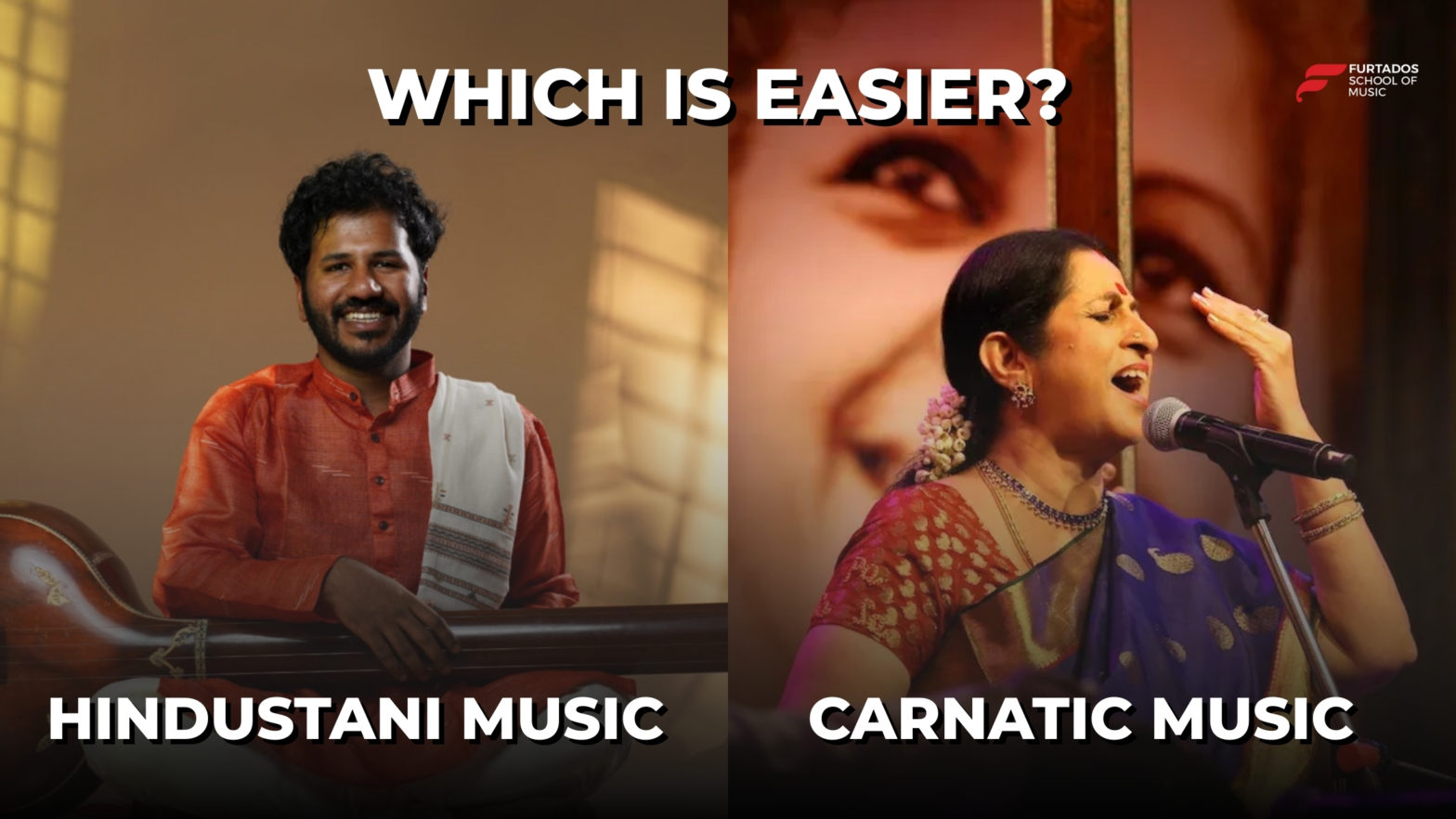
Choosing between Hindustani or Carnatic music is a question many aspiring musicians face. Both styles share ancient roots and core elements like raga (melody) and tala (rhythm), but they’ve evolved in different directions—making one feel easier or more approachable depending on your learning style.
Let’s break down the difference between Hindustani and Carnatic music and help you decide which one might be a better fit for you.
Origins & Cultural Background
Both traditions trace back to Vedic chants and the Natya Shastra, but diverged over time:
- Hindustani music (North India) incorporated Persian and Islamic influences from the 13th century onwards, giving rise to improvisational styles like Khyal and Dhrupad .
- Carnatic music (South India) remained closely tied to Bhakti‑era devotional compositions by masters like Tyagaraja and Dikshitar, prioritizing structured, lyric-based pieces known as kritis
Structure vs. Flow: How Each Tradition Evolves a Raga
Carnatic Music
- Very structured: each concert follows a set progression—varnam, several kritis, then improvisation through alapana, neraval, kalpana swaram, and Ragam–Tanam–Pallavi
- Learners adopt a step-by-step Saragathi to Swarajati to Varnam approach, advancing toward full kritis
- Use of melakarta system with 72 parent ragas, mathematically defined and charted
Hindustani Music
- More fluid: lessons often begin with an alap—a slow, free-form exploration of the raga, followed by rhythmic jor/jhala and then compositions (bandish) in vilambit and drut tempos
- Learners are encouraged to immerse and improvise early on, with ragas tied to time-of-day or seasons, and a focus on emotional mood through meend, taan, and bol-banaa
Rhythm & Tala: Complexity vs. Creativity
- Carnatic tala system is highly mathematical—Adi, Rupaka, Khanda Chapu and others with intricate improvisations like korvais and teermanams .
- Hindustani talas (e.g., Teentaal, Ektaal, Jhaptal) are cyclic but offer more freedom within improvisation, especially with tabla accompaniment .
Instrumentation & Role of Voice
- Carnatic music emphasizes voice—veena, violin, mridangam, ghatam, and kanjira are typical in concerts .
- Hindustani concerts highlight instruments like sitar, sarod, tabla, bansuri, and harmonium, with vocal styles such as Dhrupad, Khyal,Thumri, and Tarana .
Which Is Easier for Beginners?
Carnatic Music Might Be a Smoother Start If You Prefer:
- A structured learning path—progressing from exercises to compositions with clear milestones.
- Learning through notations and following well-defined frameworks (melakarta, tala structures).
- A focus on memorized compositions, interspersed with guided improvisation
Hindustani Music Might Suit You If You Prefer:
- Expressive freedom—exploring a raga early through improvisation.
- A feel-first approach, soaking in the raga through listening before breaking it down.
- Emotional immersion tied to time and season with less emphasis on structure initially.
Commitment Matters: Passion & Discipline Required Either Way
Whether you choose learning Carnatic music or Hindustani, both require:
- Daily practice and vocal discipline
- Understanding of raga grammar
- Rhythmic awareness and ability to improvise
- Emotional connection with each raga’s mood (bhava and rasa)
Final Thoughts
There isn’t a definitive answer to “Which is easier?” It depends on your learning style:
- Prefer order, structure, and compositional depth? Carnatic may feel more beginner-friendly.
- Prefer mood-based immersion, expressiveness, and dynamic improvisation? Hindustani might align better.
Either path demands dedication, passion, and discipline—and both traditions share the same ancient roots and eternal beauty.
Begin Your Journey with FSM
Whether you choose Hindustani vs Carnatic, FSM offers expert-led courses in both traditions:
- Carnatic music classes: structured curriculum from beginner lessons to concert readiness
- Hindustani music classes: expressive, improvisation-focused training
Whichever path you take, FSM equips you with the technical, emotional, and rhythmic tools to grow as a classical musician. Your classical music journey starts here!