Close your eyes and think of your favourite film scene. What do you still hear? Often it is not the dialogue. It is a flute note, a rising drumbeat, or a quiet swell of strings. Music tells us how to feel before a character speaks.
That is why the Ramayana movie music has families talking this Diwali. The film opens internationally on 6 November and in India on 8 November. Its soundtrack is already playing in homes everywhere. For students and parents, it is a rare lesson in how sound shapes emotion. It is also a story about people from different backgrounds coming together around one epic.
A Hindu Epic, Shaped by Many Faiths and Cultures
The Ramayana is sacred to millions of Hindus. The score for this film comes from two composers who each bring a different background to it. In a recent interview, A.R. Rahman put it simply: “Hans Zimmer is Jewish, I am Muslim, and the Ramayana is Hindu. It’s coming from India to the whole world, with love.”
Rahman also said he studied in a school where the Ramayana and Mahabharata were part of every year, so the story was never new to him. He describes its heart as virtue and higher ideals, not labels. That is the point worth sharing with children. A story about goodness can be told with respect by people who pray in different ways, and music is often what brings them to the same table.
This is not a new idea. The Ramayana has travelled for centuries across Asia, from the Ramakien in Thailand to dance-dramas performed at Prambanan in Java. Every culture that tells it adds its own sounds, and the story only grows richer.
Ramayana Movie Music: Two Legends, One Sound
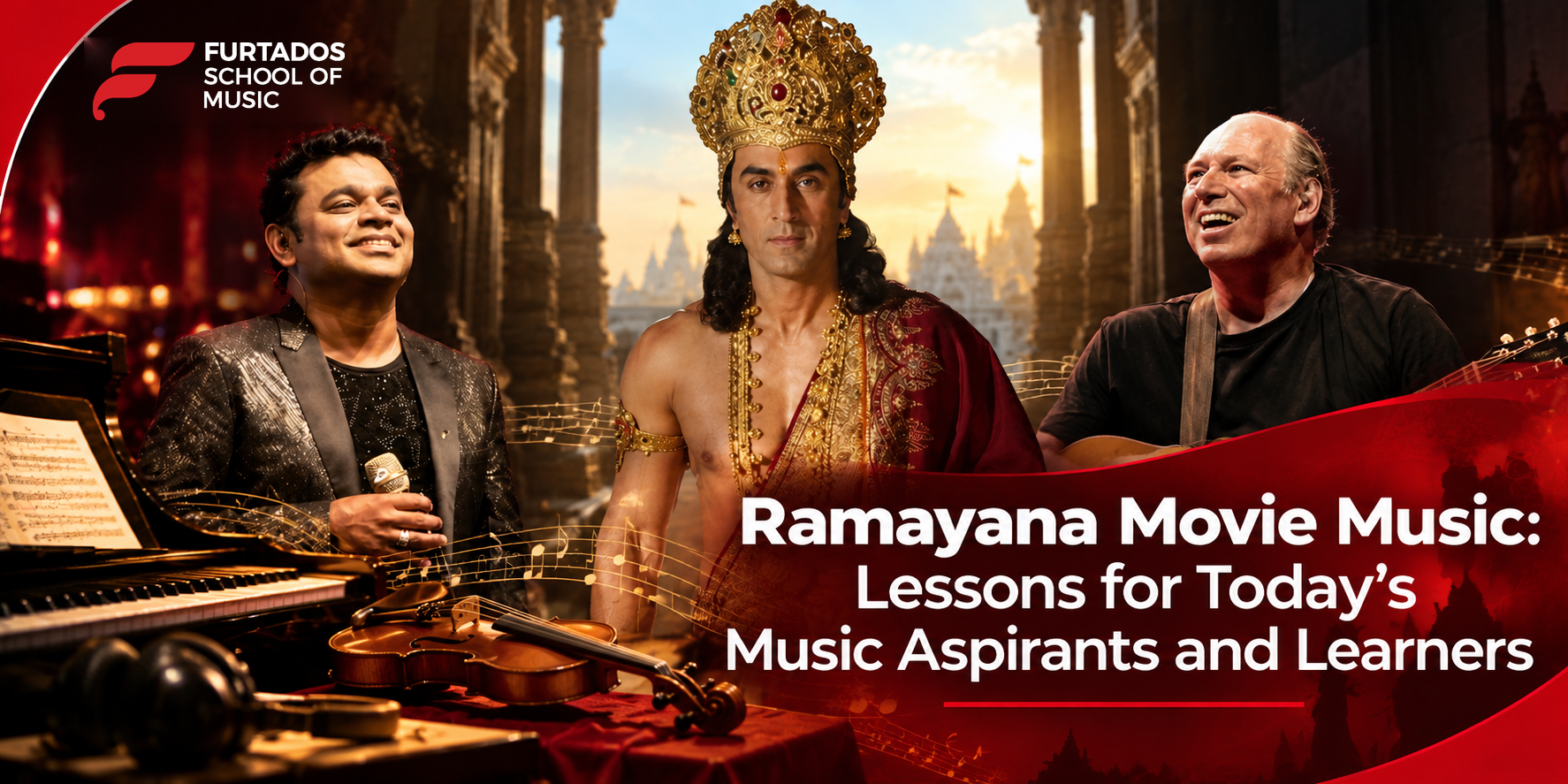
Two Oscar winners lead this score. A.R. Rahman brings deep roots in Indian melody and devotion. Hans Zimmer, known for large orchestral scores, brings scale and tension. Together they co-composed the Rama Theme, where an Eastern and a Western tradition meet in a single piece.
The five track album includes Jai Jai Ram, Ravana Tandav and Sita’s Aspiration. Arijit Singh and Shreya Ghoshal sing Jai Jai Ram. An orchestral version of the same song shows how one melody can live in two forms, with and without voices.
Sita’s Aspiration brings in several female voices, which suits a theme of longing and resilience. Hearing these songs side by side, a student can notice how voice, rhythm and mood change with the story.
Notice how each character gets a different sound. Rama’s music feels steady and devotional. Ravana’s music carries a very different energy. Ravana Tandav begins with the Shiv Tandav Stotram, a Sanskrit hymn that reflects his devotion to Shiva. Musicians call this a musical identity. It tells the audience who we are hearing without a single line of explanation.
How Indian Classical Instruments Meet the Orchestra
The trailer shows this blend clearly. In one musical breakdown, Rama’s entry builds on a rising pitch. Then brass carries a triumphant melody, joined by a choir and tabla. Ravana’s entry, by contrast, arrives with music that suggests power and menace.
Here Indian classical instruments and the Western orchestra share the work, and each has a job. The tabla gives rhythm its heartbeat, with pitch and speech-like patterns that a machine cannot copy easily. Brass adds weight and a sense of destiny. Strings lift emotional moments higher. A choir makes a scene feel larger than one person.
Other instruments bring different colours to Indian storytelling. The bansuri carries the player’s breath, which makes a melody feel calm and prayerful. The veena has a deep, resonant tone long linked with devotion. The shehnai often marks auspicious occasions. A score built from such voices feels rooted and fresh at once.
Music Is a Language Everyone Can Learn
A raga and a symphony orchestra grew up in different parts of the world. Yet when a tabla, a brass section and a choir play together, nothing feels out of place. The reason is simple. Every musical tradition is built on the same basics: pitch, rhythm, listening and feeling.
This is why music is such a gentle bridge between communities. A child does not need to share a language, faith or hometown with another child to play a duet with them. They only need to listen, keep time and respect what the other person brings. These are habits that last well beyond the music room.
Good fusion also depends on respect. Rahman and Zimmer did not simply place one style on top of the other. Each tradition keeps its own depth, and the piece works because both are heard. Young musicians can take that lesson into any band, choir or classroom.
Why Music Shapes Emotion in Everyday Life
This lesson goes far beyond cinema. We use music all day without noticing. A lullaby calms a baby. A fast playlist powers a morning run. A devotional song at dawn brings quiet to a home. A festival tune lifts an entire street.
Music works because it speaks directly to feeling. A slow tempo often relaxes us. A rising melody builds hope. Low, sustained notes create seriousness. Children sense this early, even before they can explain it in words.
A mythological film shows these tools at their widest, because the story already carries deep faith. That care matters. The Ramayana is sacred to millions, so the music must respect its spirit. Good composers choose restraint over noise, and young musicians can learn from that discipline.
What Young Musicians Can Learn from Film Scores
First, learn your roots. Rahman’s work shows how a strong base in Indian melody makes a composer original. A student who understands raga and taal has a foundation to build almost any sound later.
Second, do your homework. For Ponniyin Selvan, Rahman reportedly spent nearly six months researching the sounds of the Chola period. Great musicians study the story and the era before they play a single note.
Third, listen actively. Play the Rama Theme once and ask simple questions. Which instrument enters first? When does the rhythm arrive? What feeling changes at each entry? Notice the soft passages too. They make loud moments hit harder.
Fourth, collaborate across traditions. Two composers from different cultures and faiths shaped one score. Musicians who listen, adapt and share ideas grow faster, whether they play in a band, a choir or an orchestra.
Fifth, respect what you borrow. Learn where a sound comes from before you use it. Curiosity about other traditions makes your own music deeper, not weaker.
Music Classes for Kids: Turning Inspiration into Skill
Many parents hear a soundtrack like this and wonder if their child could play that way one day. The answer is yes, with patient and structured practice. Good music classes for kids build the skills behind great scores. These include ear training, rhythm, instrument technique and basic theory.
Start with the sound your child loves most. A child drawn to the flute can begin with bansuri or western flute. A child who loves rhythm may enjoy tabla or drums. A child who loves big orchestral sound can start with piano, which shows how harmony works.
Group lessons and ensembles add something extra. Children learn to play alongside others, adjust to each other and enjoy music together. For many families, this is where music quietly teaches openness and teamwork.
Parents can also try simple habits at home. Sing a song together, clap its rhythm, and name the instruments you hear. Try listening to music from different parts of India and the world, and talk about what feels familiar or new. These small moments build a musical ear long before formal lessons begin.
Early lessons should feel like play. Short daily practice beats one long weekend session. Graded music exams can add clear goals and stage confidence later. Look for teachers who balance technique with joy.
Careers matter too. Film music is a real profession, with composers, arrangers, session players, sound designers and singers behind every release. A child who starts early gains years of training before choosing a path.
Start Your Child’s Musical Journey This Diwali
Ramayana will fill theatres this season, and its music will stay in memory long after the credits roll. Let that moment inspire your family, not just entertain it. Ask your child which sound they loved most, then help them explore it. Book a complimentary introductory class at FSM and let your child try an instrument with expert teachers. Call 1800 266 4366. A festival of lights can become the first step of a lifelong musical journey.