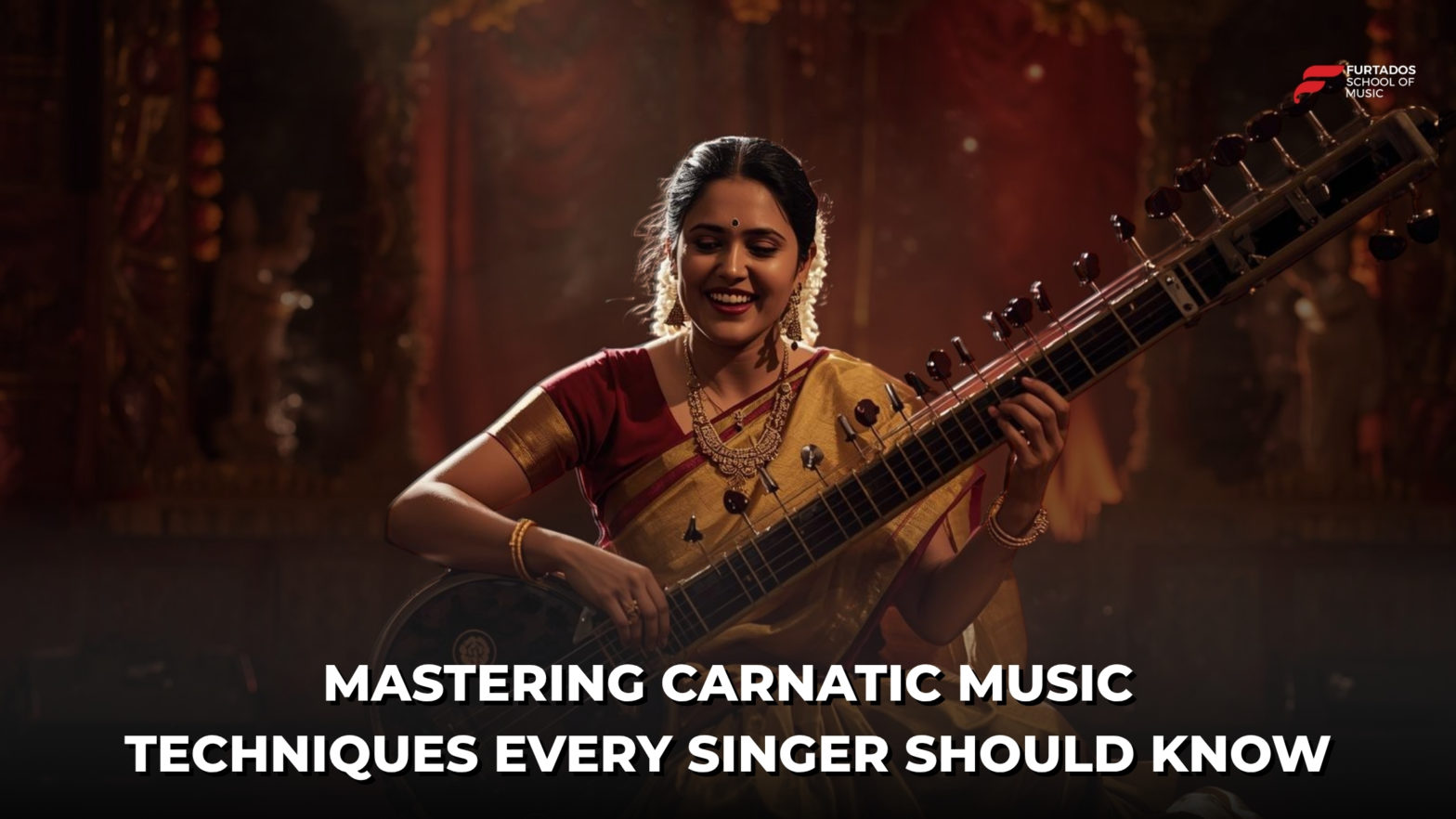
Carnatic music, with its deep-rooted tradition and unmatched intricacy, is not just a genre—it’s a discipline. Revered across South India and increasingly appreciated worldwide, Carnatic music is a spiritual, emotional, and intellectual journey for every vocalist. But what truly defines the right way to sing Carnatic music? At Furtados School of Music (FSM), we believe that mastering the art lies in understanding both the foundation and finesse. Whether you’re a beginner or someone looking to deepen your craft, this guide outlines the essential Carnatic Music techniques every singer should know.
Understanding the Core of Carnatic Music
Before diving into the techniques, it’s important to acknowledge the philosophy behind Carnatic music. Rooted in Bhakti (devotion), Carnatic singing emphasizes both precision and expression. Unlike many western styles, it demands a fine balance between structure and improvisation—between discipline and creativity.
The Right Way Begins with Shruti (Pitch)
One of the first Carnatic singing tips every learner hears is: “Shruti is mata (mother); Laya is pita (father).” Shruti, or pitch, is the very soul of Carnatic performance. Maintaining perfect pitch is not optional—it’s essential.
- Start every practice session by tuning your voice to the Tanpura or shruti box.
- Ear training is crucial. At FSM, students undergo regular listening exercises to develop pitch accuracy.
- Stay committed to one shruti during a session—it builds consistency and vocal memory.
Master the Building Blocks: Swaras, Ragas, and Talas
1. Swaras (Notes):
Carnatic music is built on seven swaras—Sa, Ri, Ga, Ma, Pa, Da, Ni. But what brings them alive is how they’re used in context.
- Practice ascending (Arohanam) and descending (Avarohanam) note patterns.
- Use sarali varisais and janta varisais as your daily vocal warm-ups.
2. Ragas (Melodic Frameworks):
Every raga is a mood, a story. Understanding its grammar is vital, but feeling the raga is just as important.
- Start with simpler ragas like Mohanam or Malahari.
- Learn the characteristic phrases (prayogas) of each raga to sing it with authenticity.
- At FSM, instructors often guide students with real-time raga comparisons to help them understand nuances.
3. Tala (Rhythm):
Tala is the rhythmic cycle that gives structure to a composition. Popular talas like Adi, Rupaka, or Khanda Chapu form the basis of most beginner compositions.
- Use hand gestures (angas) to internalize tala cycles.
- Practice singing with a metronome or electronic tala box for timing accuracy.
Voice Culture and Gamakas (Ornamentation)
An often-overlooked part of how to sing Carnatic music is voice culture. Carnatic vocalists must develop stamina, clarity, and agility.
- Regular voice exercises help strengthen vocal cords without straining.
- Learn to control breath, especially during long, intricate phrases.
- Gamakas, or microtonal oscillations, are the soul of Carnatic music. Begin with basic oscillations in familiar ragas and gradually build mastery.
Internalize Before You Improvise
Carnatic music isn’t just about memorizing compositions—it’s about understanding their structure. Only then can you move to improvisational elements like:
- Alapana – free-flowing raga exploration
- Niraval – improvising within a line of a composition
- Kalpana Swaram – creative swara patterns
At FSM, students are introduced to these gradually, after mastering compositions like Geetams, Varnams, and Kritis.
Tips for Serious Learners
Here are a few practical Carnatic singing tips to stay on the right path:
- Record your practice and playback to self-analyze
- Study legendary vocalists like M.S. Subbulakshmi, Dr. M. Balamuralikrishna, or T.M. Krishna
- Attend live concerts and online workshops regularly
- Keep a dedicated practice schedule and stick to it—consistency builds vocal intelligence
The Legacy You Join
When you begin your journey into Carnatic music, you’re joining a lineage that has evolved over centuries. And yet, it remains ever-relevant. Today, artists across India and abroad continue to innovate while preserving its essence.
At Furtados School of Music, we aim to make this rich tradition accessible to learners of all ages and backgrounds. Whether you’re just beginning or picking it up after years, the right guidance and techniques can help you blossom into a confident Carnatic vocalist.
Final Note
Mastering Carnatic Music Techniques takes time, patience, and deep passion. There’s no shortcut—but with the right techniques, discipline, and love for the art, the journey itself becomes the reward.
Whether you’re singing your first raga or exploring complex kritis, remember: the right way isn’t just about singing correctly—it’s about singing soulfully.