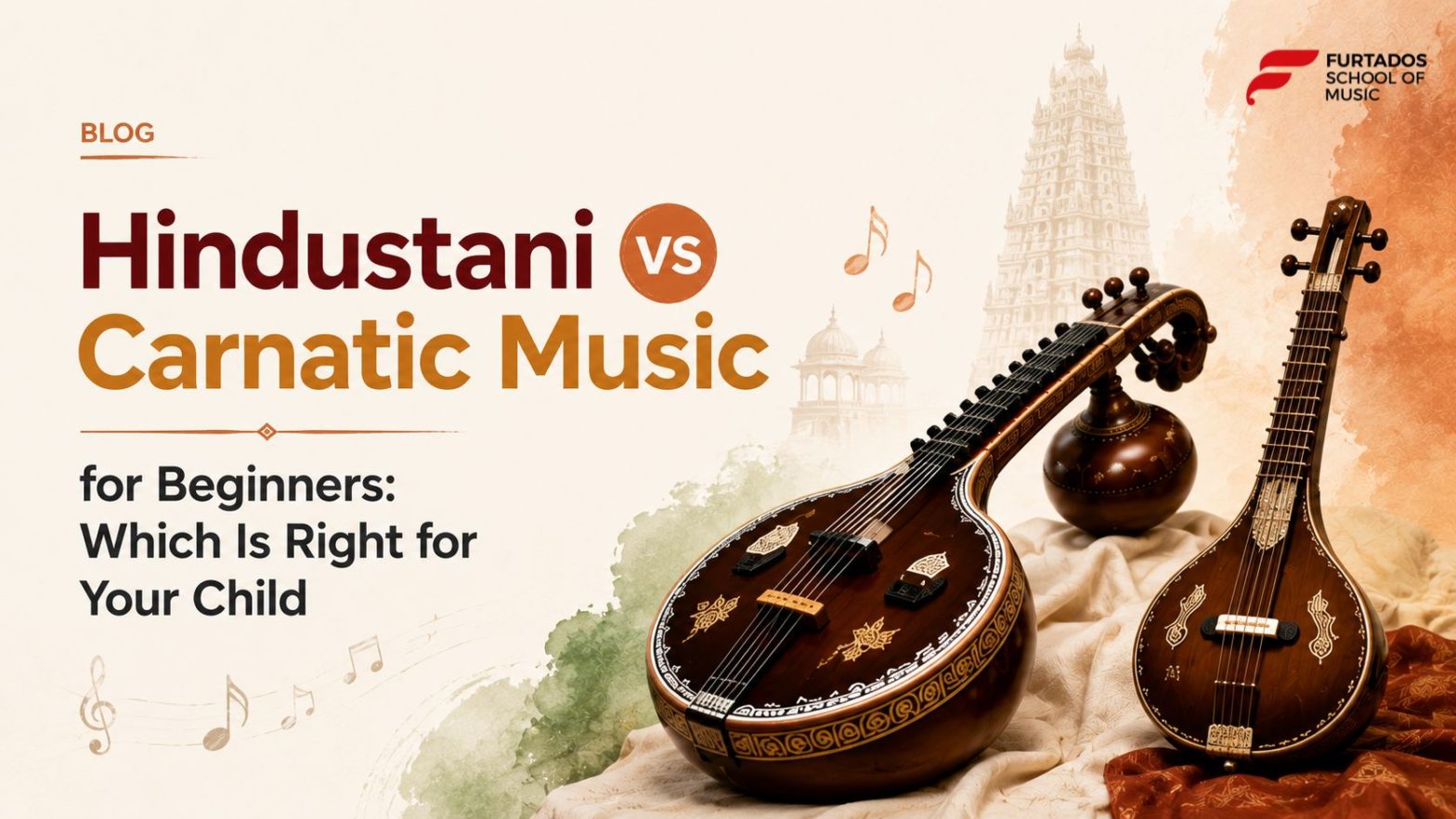
A lot of parents walk into this decision assuming it’s like choosing between two schools of the same subject – pick the better one and move on. It doesn’t quite work that way. Hindustani vs Carnatic music isn’t a question of which tradition is stronger; it’s two distinct systems, each shaped by a different history, and each suited to a slightly different kind of learner. Getting this right early saves a fair amount of switching-back-and-forth later.
Two Traditions, One Root
Both systems grew out of the same ancient framework of raga (melodic structure) and tala (rhythmic cycle), but they went their separate ways over several centuries. Hindustani music, practiced largely in North India, absorbed a strong Persian and Mughal court influence, which shows up in its emphasis on improvisation and mood. Carnatic music, rooted in South India, stayed closer to its temple and devotional origins, and leans more heavily on fixed, structured compositions.
Neither history makes one system more “authentic” than the other – they simply produced different teaching styles, and that’s really what matters for a beginner.
What a Beginner Actually Experiences: Hindustani
A child starting Hindustani classical music for beginners usually spends the early months on voice culture and raga recognition – learning to identify and sing basic ragas before moving into any real improvisation. There’s a fair amount of listening involved early on, since Hindustani training leans on ear-based imitation of a teacher (this is the gharana system at work) more than written notation.
Children who enjoy a bit of open-endedness tend to do well here. Once the basics are in place, Hindustani music makes room for a student’s own interpretation within a raga, rather than reproducing something note-for-note every time.
What a Beginner Actually Experiences: Carnatic
Carnatic music for beginners tends to follow a clearer, graded ladder – starting with sargam exercises (similar to solfège), moving into short fixed compositions called geethams, then varnams, and eventually full kritis. Because the early repertoire is fixed rather than improvised, it’s easier for both the child and parent to track visible progress lesson to lesson.
This structure tends to suit children who like clear milestones and a defined syllabus – the kind of learner who’s motivated by “I finished this piece” rather than open-ended exploration.
So Which One Actually Fits Your Child?
This is where most articles dodge the question, so it’s worth being direct: neither system is objectively easier or more rewarding, but a few practical factors usually settle it quickly. If your child does better with a visible checklist and enjoys mastering one clear piece before starting the next, Carnatic’s structured pedagogy tends to hold their attention. If they get bored following a fixed script and enjoy playing around with a tune, Hindustani’s room for interpretation usually keeps them more engaged.
Family background and exposure matter too. A child who’s grown up hearing classical music for kids from one tradition at home – through festivals, family listening habits, or regional language – often finds that starting point far more natural than the other, simply because the melodic and rhythmic vocabulary already sounds familiar.
Instrument choice can tip the decision as well. Certain instruments are more strongly associated with one tradition – the sitar and tabla sit naturally within Hindustani training, while the veena and mridangam are Carnatic mainstays. If a child has already shown interest in a specific instrument, that often points toward the tradition it belongs to.
It Doesn’t Have to Be Permanent
One thing parents often don’t realise: starting in one tradition doesn’t lock a child out of the other later. Plenty of musicians study both across their training, especially once foundational listening and rhythm skills are in place. The early choice matters mostly because it shapes how a young beginner’s ear and habits form first – not because it’s an irreversible fork in the road.
Getting Started the Right Way
The honest answer to Hindustani vs Carnatic music is that the right choice depends on the child in front of you, not a general ranking of one system over the other. Furtados School of Music offers structured beginner programs in both traditions, with faculty who can help assess which style of learning is likely to hold your child’s interest before you commit. If you’re weighing this decision, it’s worth having a short conversation with FSM’s faculty before choosing a starting point.